
Bishop Museum Announces Two New Cultural Installations
Bishop Museum Announces Two New Cultural Installations
Bishop Museum, the State of Hawaiʻi Museum of Natural and Cultural History, shares two new cultural installations in its historic Hawaiian Hall Complex. The new additions uplift both traditional and contemporary Native Hawaiian themes and movements.
15 New Pieces Rotated Into the Ongoing Ea Mai ʻEiwa: Patterns of Practice Exhibition
- Ongoing exhibition in the J. M. Long Gallery, Hawaiian Hall Complex
- Runs through Feb. 15, 2027
- Exhibition webpage: BishopMuseum.org/Eiwa
- Previous news release with additional information
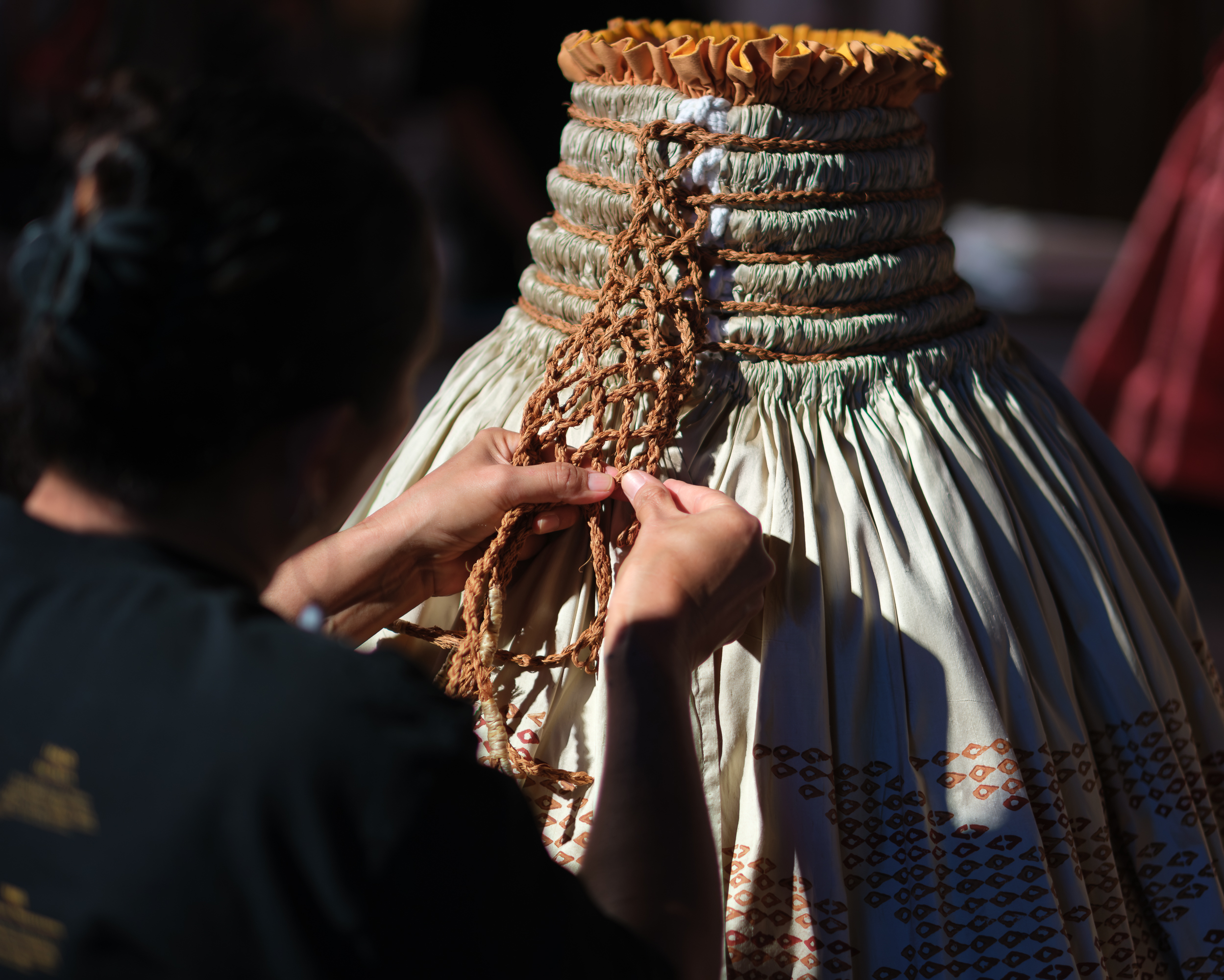
To celebrate the show's extension through Feb. 15, 2027, 15 new pieces have been rotated into the Ea Mai ʻEiwa: Patterns of Practice exhibition ("ʻEiwa"). The rotation includes items from Bishop Museum's collections as well as works by ʻEiwa's three exhibiting artists, Nālani Kanakaʻole (1946-2026), Sig Zane, Kūhaʻoʻīmaikalani Zane, and their collaborators.
"2026 is the year of Nālani Kanakaʻole," said Sarah Kuaiwa, Ph.D., Bishop Museum curator for Hawaiʻi and Pacific Resources, and ʻEiwa co-curator. "We are so fortunate to have the opportunity to tell more stories around the collaboration between Nālani Kanakaʻole, her ʻōlapa (students), and ʻohana (family). The ensemble of nine models assembled for this exhibition rotation illustrate the continuity of Kanakaʻole's design theory which is perpetuated by her ʻōlapa."
One of the major themes of the exhibition is the evolution of genres of traditional craft. The pāʻū (skirt) is the most important garment worn by hula practitioners. Pāʻū enhances the spiritual function of hula and moves with hula's exacted and intentional choreography.
During her time as creative director of Hālau o Kekuhi, Kanakaʻole experimented with traditional and modern materials and technical folding and binding techniques, to enliven and complement her choreography. Her design theory was influential to many contemporary kumu hula and after her passing, her ʻōlapa continues her legacy and instruction to innovate.
The new additions to ʻEiwa include an ensemble of nine models on the main stage of the exhibition.
In 2020, Kanakaʻole created a series of pāʻū titled "The Five Wives of Kumukahi (2020)" inspired by Kumu Hula Joseph ʻĪlālāʻole's (1873–1965) moʻolelo (story) of the same name. Seldom seen since their creation, "The Five Wives of Kumukahi" pays homage to Kanakaʻole's teachers and fashion influences while also demonstrating the functions of the wives and the geographical markers they lend their names to.
"The Five Wives" are placed in conversation with four new creations made after Kanakaʻole's passing by her ʻōlapa (students): Sig Zane, Pua Kinkini, Kehauwealani Kaula, Ulumauahi Kealiʻikanakaʻoleohaililani, Myoung-Ja Hwa, Kiʻikaleʻaopōhakulani Hoʻopai Keliʻi, and Hinamanouluaʻe Kealiʻikanakaʻoleohaililani. Specifically created for the exhibition, the models demonstrate the perpetuation of Kanakaʻole's teachings and the care that her students have for her lessons.
Also new are:
- Kūhaʻoʻīmaikalani Zane's video projection installation, ʻIke Pāpālua (2026). ʻIke Pāpālua is a meditation on the transference of knowledge between generations. Zane interweaves ʻohe kāpala and oli with projection technology, encouraging audiences to engage with the past and future on the same plane. Featured in the video is a reggae version of the ʻoli "Kūhaʻimoana" composed by Ulumauahi Keliʻikanakaʻoleohaililani and Ikaakamai.
- Three Bishop Museum kapa pieces that act as a direct connection to the pāʻū ensemble made by Kanakaʻole and her students.
"None of the nine models are alike in material, technique, color, or style," shared Kuaiwa. "I think our visitors will be surprised to see these pāʻū because of their individual uniqueness and craftsmanship. I am excited to see how the models interact with the existing works in the gallery in ways that are different from the gallery's previous iteration."
New Hawaiian Hall Third Floor Treasure Case Installation: Kanaloa ka Laʻa o Kohemālamalama: Unconquerable is the Divinity of Kohemālamalama
- New Treasure Case installation on the third floor of Hawaiian Hall
- Runs through April 2027
- Previous news release with additional information
Continuing the celebration of the 50th Anniversary of the Protect Kahoʻolawe ʻOhana, Bishop Museum announces a new installation in its Hawaiian Hall third floor Treasure Case: Kanaloa ka Laʻa o Kohemālamalama: Unconquerable is the Divinity of Kohemālamalama.
Kohemālamalama o Kanaloa is a traditional name for Kahoʻolawe. The title of the installation speaks to the sacredness of the island, its enduring relationship with Kanaloa, and the spiritual and cultural foundations that remained despite the profound damage Kahoʻolawe experienced through ranching, military use, bombing, and restricted Native Hawaiian access.
Co-curated by Pūlama Lima, Bishop Museum curator of Archaeology, and the Protect Kahoʻolawe ʻOhana, the installation examines the cultural and spiritual foundation of the movement and the central role that ʻaha and Hawaiian religious practice have held within the ʻOhana throughout its 50-year history. ("ʻAha" has multiple meanings but in this context can be interpreted as "ceremony.")
Kanaloa ka Laʻa o Kohemālamalama: Unconquerable is the Divinity of Kohemālamalama brings together historical objects and archival materials from Bishop Museum's collections, with contemporary photographs and pieces from the Protect Kahoʻolawe ʻOhana. Historical materials, including objects documented and collected from Kahoʻolawe before U.S. military occupation, provide a window into the island's longstanding cultural and religious significance. Alongside them, materials from the ʻOhana document how ʻaha became foundational to the movement beginning at Hakioawa in 1976, and how the ʻOhana continued to deepen and elevate these practices over the decades.
Many of the Museum's collection items featured in the installation are associated with archaeologist John F. G. Stokes' 1913 visits to Kahoʻolawe and his documentation of Kamōhio Bay. These include:
- a kiʻi lāʻau (a traditional carved wooden representation of akua (deity) or ʻaumakua (ancestral guardian))
- kūʻula stones associated with fishing (traditional stone deities and sacred objects)
- kiʻi pūnohu (sacred images carved into the spine of a slate pencil sea urchin)
- a historical map of Kahoʻolawe
- a historical ʻapu of Kahoʻolawe (a traditional drinking cup fashioned from half of a coconut shell)
Stokes' documentation of Kamōhio recorded a place of ceremonial practice and preserved objects and information that help us better understand the longstanding relationships between Kānaka (man), akua, ʻāina (land), and the resources of Kahoʻolawe.
The installation brings these historical collections into conversation with contemporary photographs and pieces from the Protect Kahoʻolawe ʻOhana, including:
- ʻapu
- an ʻauamo (traditional carrying pole)
- a kōkō (carrying net used to hang ʻumeke (food calabashes))
Together, these materials allow visitors to see both continuity and the intentional development of ʻaha within the movement. The contemporary pieces reflect how members of the ʻOhana continued to practice and strengthen ʻaha as their relationship with Kahoʻolawe developed.
"I hope visitors (to the Museum and the installation) leave with a deeper appreciation for the Protect Kahoʻolawe ʻOhana and for the cultural and spiritual foundation of the movement," said Lima. "We often remember Kahoʻolawe through the occupations, the bombing, and the political struggle to return the island, and those histories are incredibly important. But alongside that history is an equally important story of ʻaha, Hawaiian religious practice, and the conscious rebuilding and strengthening of relationships with akua, kūpuna (ancestors), and ʻāina."
"For me, that continuity is one of the most meaningful parts of this story," Lima shared. "The ʻOhana understood that returning to Kahoʻolawe also meant returning to practices and ways of understanding our place within the world that had sustained Hawaiians for generations. That consciousness shaped how they approached Kahoʻolawe and their kuleana (responsibility) to the island. I hope the installation helps people recognize the importance of that foundation and consider what it continues to offer us as a lāhui (people) today."
Note: Photos of both installations are available via Stryker Weiner & Yokota Public Relations.
About Bernice Pauahi Bishop Museum, the State of Hawaiʻi Museum of Natural and Cultural History
Bishop Museum’s mission is to inspire our community and visitors through the exploration, celebration, and perpetuation of the extraordinary history, culture, and environment of Hawaiʻi and the Pacific. The Museum was founded in 1889 by Charles Reed Bishop in memory of his wife Bernice Pauahi Bishop, a royal descendant of King Kamehameha I. Today, the Museum thrives as an educational center for the community and is widely regarded as the world’s premier institution for Hawaiian and Pacific content.
Bishop Museum’s vast collections of more than 25 million objects and specimens represent nine disciplines and include more than 22 million biological specimens, over 2 million cultural objects, 115,000 historical publications, and 1 million photographs, films, works of art, audio recordings, and manuscripts. These collections tell the stories of the cultures and biodiversity of Hawaiʻi and the Pacific as well as the proud legacy of scholarly research spanning 130 years.
Bishop Museum proudly serves more than 200,000 visitors each year, including 20,000 children on school visits. Guests are encouraged to pre-plan their trip to #HawaiisMuseum with its free digital guide, available through Bloomberg Connects.
To learn more about the Museum’s research, collections, exhibits, and programs, visit BishopMuseum.org, follow @BishopMuseum on Facebook and Instagram, visit Bishop Museum’s YouTube channel, or call (808) 847-3511. Bishop Museum is a 501(c)(3) nonprofit organization.
Bishop Museum is proud to be an Equal Employment Opportunity and Affirmative Action Employer, and welcomes applicants from the military, veterans, and those with disabilities. Learn about careers at Bishop Museum at BishopMuseum.org/Careers and on its LinkedIn page.
Bishop Museum Press is Hawaiʻi’s oldest book publisher and one of the first scholarly publishers in the Western Hemisphere, and has published over 1,200 titles and distributed over 1 million books in 72 countries worldwide. Bishop Museum hosts a restaurant and gift shop on campus, Tūtū’s Place by Highway Inn and Shop Pacifica by Nā Mea Hawaiʻi.